German flashcards for Anki, with audio and pictures
German words that finally stay in your head. These are ready-made German vocabulary decks for Anki, A1 to C1, with meanings in English or Arabic. Every card gives you the word, a picture, natural German audio, a casual and a formal sentence, usually du and Sie, and the grammar you actually need when you speak. Start with the free A1 deck and see for yourself.
This is a real card. Tap it to turn it over and press play to hear the German.
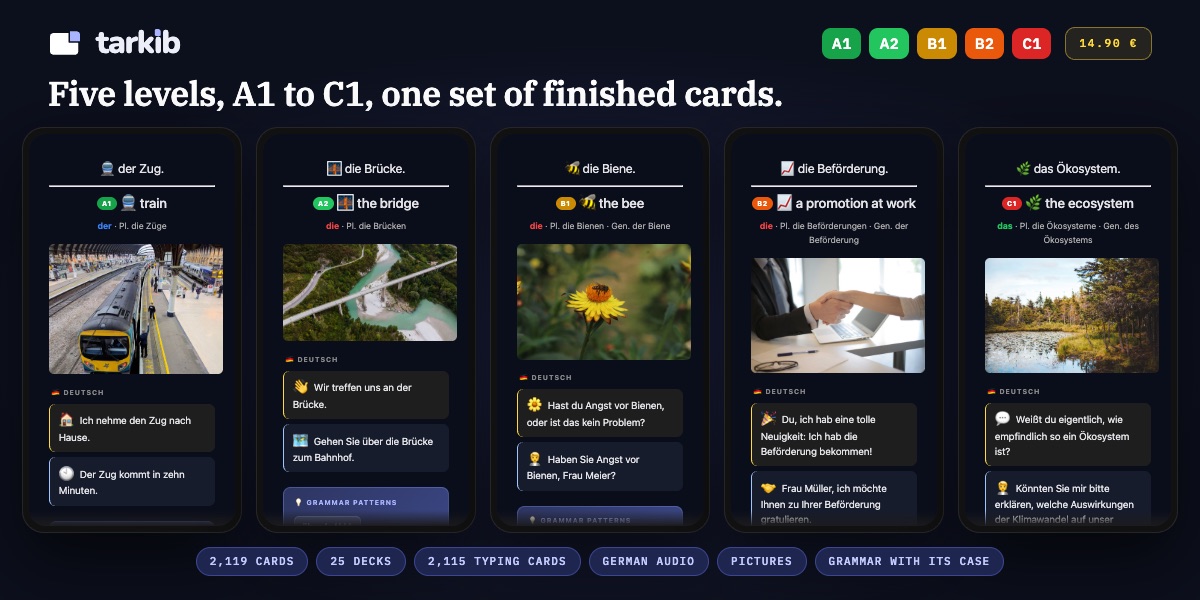
2,119 word cards plus 2,115 typing cards from A1 to C1, and every level splits into five decks. Works on Windows, macOS, Linux, Android and iPhone.
Eight things on a card
Most decks give you a word and a translation. That is why they are boring and why the words never stick. These cards give your memory something to hold on to.
Natural German audio
Every word is spoken by a natural German voice, and every typing card reads its sentence aloud, so you learn how it really sounds.
A picture for the word
Your brain remembers pictures far better than text. Each card carries an image chosen for that word.
Friendly and formal
Two example sentences, both with their meaning. One casual and one formal, usually with du for a friend and Sie for an office or a government desk. The difference gets noticed in Germany.
The grammar you need
The article for every noun, and the plural when it has one. Verb forms, and the preposition that goes with a word, written with its case. Checked, not guessed.
A fill-in-the-blank card
2,115 of the 2,119 cards have a typing card as well. You write the missing word and it is checked letter by letter. See one, front to back.
Emojis that set the scene
A small emoji for the word, and one for each sentence, so your memory has a picture to hang on to. ✈️ for das Flugzeug, 💬 for the friendly line, 🏢 for the formal one.
Your own language
Meanings in English or Arabic. Pick the one you think in, and switch later without losing your progress.
A line in simple German
One short explanation of the word, written in easy German, so you meet the word in German and not only through a translation.
Five decks, not one long list
You can already get a German word list free, and you should not pay for one. So this is not a word list. Every level splits into five decks, and each one holds a different kind of thing you have to learn. A noun with its article is not the same job as warten auf with the Akkusativ, so they do not sit in the same pile.
1 Wortschatz
der Schlüssel does not arrive on its own. It comes with der and with die Schlüssel, so the article and the plural are learned as one thing. Adjectives, adverbs and the small connecting words sit in this deck too.
1,441 cards, 212 of them at A12 Verben
You reach for the past tense and take a guess. This deck has the real forms. A strong verb keeps the vowel change Germans actually say, instead of a regular ending invented for it, and a separable verb is marked trennbar, so you know the prefix moves to the end.
372 cards, 65 of them at A13 Verben mit Präposition
You know the verb. You are already halfway through the sentence. Then you need the preposition and the case, and you guess. warten auf with the Akkusativ is one card in here. This is the thing that fails you while you are speaking.
110 cards, 5 of them at A14 Redemittel
Set phrases for doing something with language. How to open a formal email. How to complain and still sound polite. How to disagree without sounding rude.
125 cards, 14 of them at A15 Redewendungen
Idioms and fixed expressions. The lines where you know every single word and the sentence still means something else. You meet them once here instead of in the conversation.
71 cards, 9 of them at A1| Level | 1 Wortschatz | 2 Verben | 3 Verben mit Präposition | 4 Redemittel | 5 Redewendungen | All |
|---|---|---|---|---|---|---|
| A1 | 212 | 65 | 5 | 14 | 9 | 305 |
| A2 | 278 | 66 | 23 | 29 | 13 | 409 |
| B1 | 480 | 138 | 30 | 33 | 24 | 705 |
| B2 | 275 | 63 | 17 | 22 | 17 | 394 |
| C1 | 196 | 40 | 35 | 27 | 8 | 306 |
| All five levels | 1,441 | 372 | 110 | 125 | 71 | 2,119 |
Tarkib German::A1::1 Wortschatz, then 2 Verben, and so on down to 5 Redewendungen. Click one and Anki studies that deck and its typing cards, and nothing else. Under each of the five sits a Cloze deck holding those typing cards.
The five names are the same at every level, so what you learn to do at A1 still works at C1. A1 is the smallest level, and its Verben mit Präposition deck holds five cards. Import the free A1 deck first, look at the five names, then decide.
One sentence, one missing word, and you write it
This is easier to show than to describe. Take die Verspätung from the A2 level, and the sentence Der Zug hat heute zwanzig Minuten Verspätung. Here is the whole card, front to back, in the order you meet it. 2,115 of the 2,119 cards have one like it.
- You see the picture and the gap The front shows the picture for the word, then Der Zug hat heute zwanzig Minuten Ver... You get the first letters as a hint. You do not get the ending, and the ending is usually the part that goes wrong.
- You hear the sentence with the word left out The card reads the sentence out loud with the missing word left out, and a pause where it belongs. You hear the German around the word before you decide what the word is.
- You type your answer There is a real text box on the front. You write Verspätung, umlaut and all, and press Check. No options to pick from, nothing to guess between.
- You are shown exactly what was wrong The check goes character by character, so you can see the single letter between your answer and the German one. A missing umlaut is marked. Capital letters are not counted, so verspätung with a small v still passes.
- The back fills in the rest The complete sentence plays, the translation is there, and a grammar note tells you what you were dealing with. On another card that note reads Akkusativ Plural, feminine noun die Wurzel.
One card, three skills. Typing and spelling, listening, and reading. It will not teach you to speak. That part still happens out loud, with a person in front of you.
Try the whole A1 level, not a sample
A1 is free and it is complete. Not ten example cards, not a locked preview. Study it for a few weeks, and if the cards work for you, the rest of the levels are waiting.
| Level | Word cards | Typing cards | What it covers | Price |
|---|---|---|---|---|
| A1 | 305 | 304 | First words, daily life, getting by | Free |
| A2 | 409 | 408 | Work, appointments, shopping, health | 4.90, or in the set |
| B1 | 705 | 704 | Opinions, feelings, offices and paperwork | 4.90, or in the set |
| B2 | 394 | 393 | Discussion, work life, abstract ideas | 4.90, or in the set |
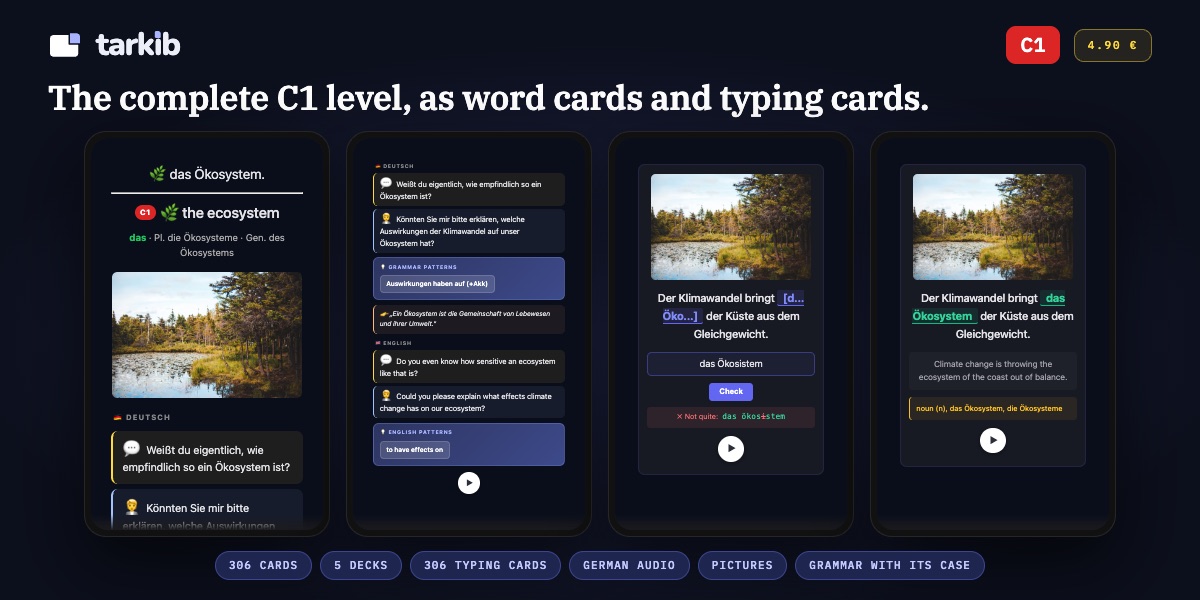
| C1 | 306 | 306 | Formal writing, nuance, advanced speech | 4.90, or in the set |
Each paid level is 4.90 on its own. All five together are 14.90, and that includes a C2 level if one is added later.
Packs for the places you actually go
Frequency lists and open CEFR references decide what goes into A1 to C1. Your week does not run on a frequency list. The topic packs take one place at a time and give you the words for that place. There is no supermarket pack, no sport pack and no Behörde pack. There is a list and there is nothing else, and I am not giving you a date, because I do not have one.
Im Supermarkt
It would cover the deposit on a bottle, the words on a shelf label, and what you say at the till when the machine will not take your empties.
Sport
Signing up at a Verein, the word for the ache that arrives two days later, and the verbs a trainer uses while you are still out of breath.
Bei der Behörde
Booking a Termin and moving it, the polite way to ask someone to say that again, and the word for the document they tell you is missing.
If the pack you need is not one of these three, the last section on this page is where you tell me.
See exactly what you get
Every level as it looks in Anki. A1 is free, the other levels are 4.90 EUR each, or 14.90 EUR for all five.
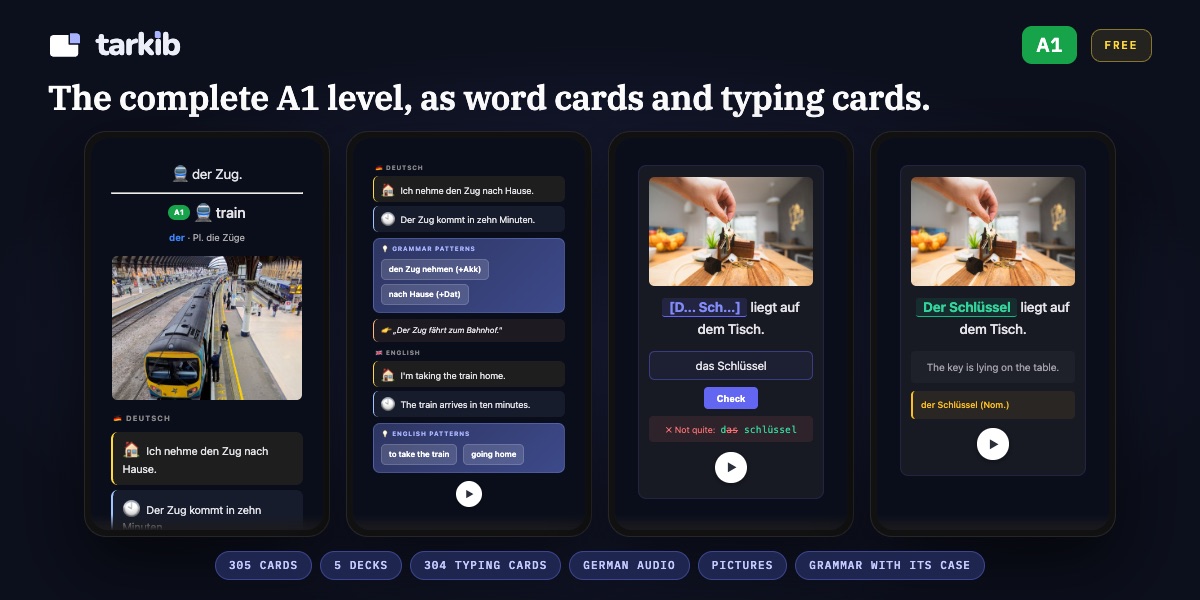
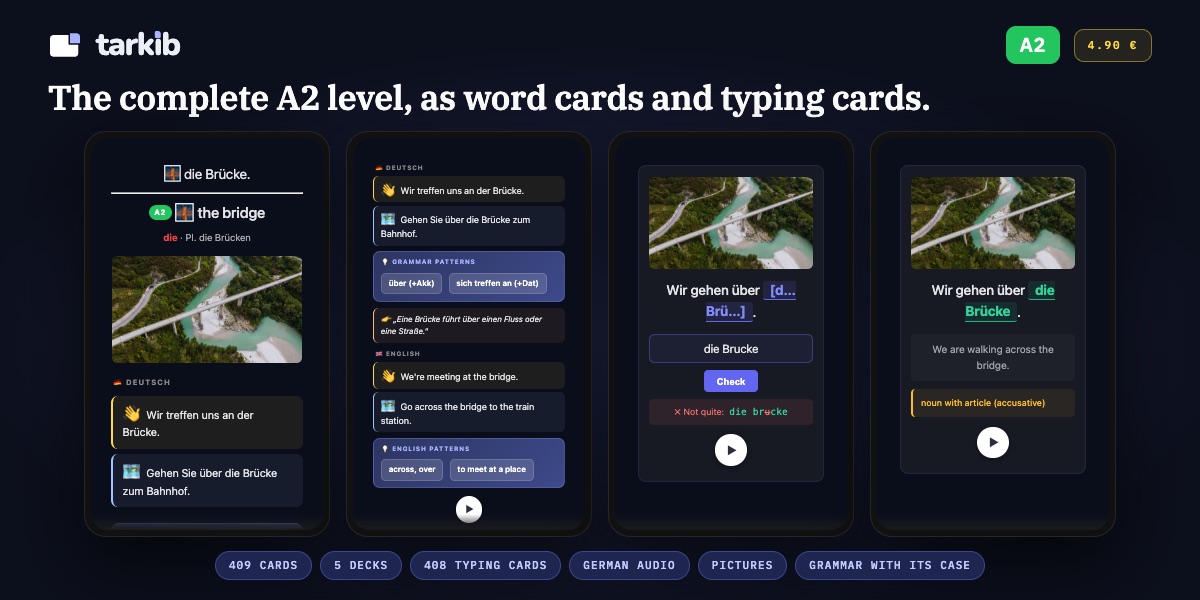
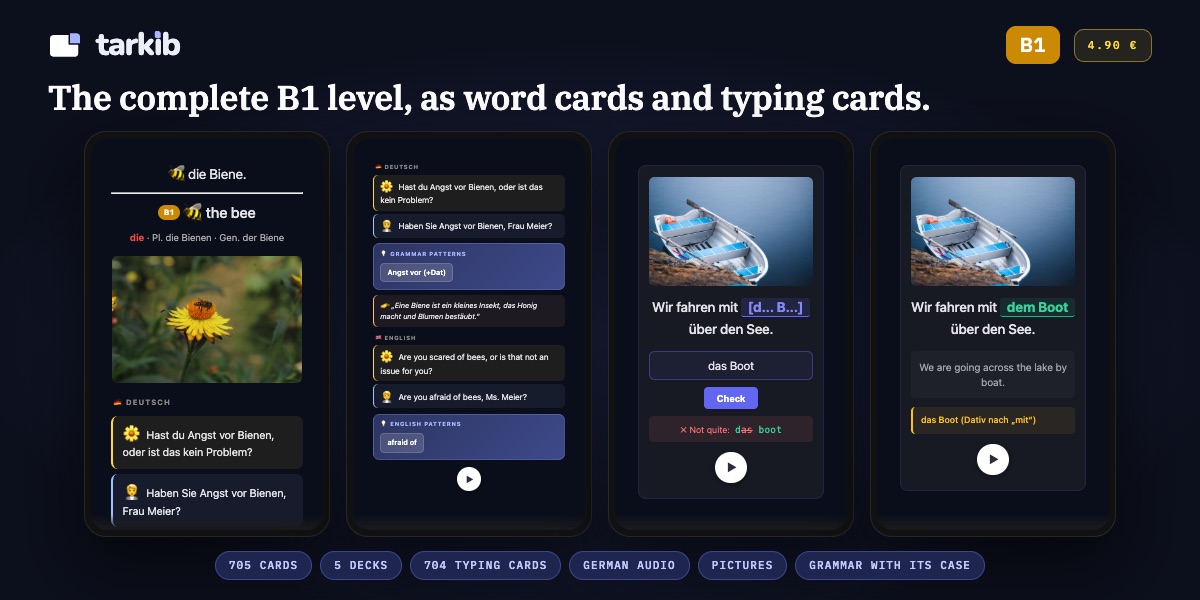
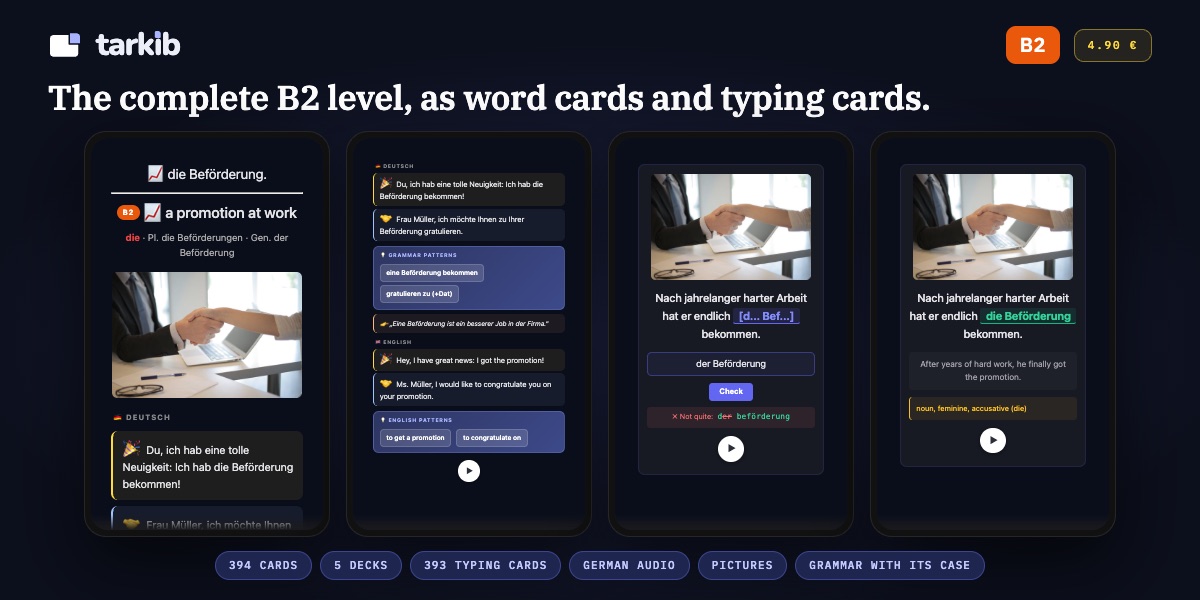
- 305 word cards plus 304 typing cards, the complete A1
- Audio, pictures and example sentences
- English or Arabic meanings
- No payment and no Ko-fi account needed
Also on AnkiWeb, English edition
Get the free A1 deck- All five levels for about the price of three
- 4,234 flashcards in five levels: 2,119 word cards plus 2,115 typing cards
- Free updates, and a C2 level if one is added later
- Imports on top of your free A1 with no loss
- One payment, yours to keep
Single levels, A2 to C1, are 4.90 EUR each. See them in the Ko-fi shop
The cards were made with Claude, Anthropic's AI, then reviewed and fixed by a person, card by card, over several rounds. The audio comes from a licensed voice service, and the pictures are licensed too.
Three steps and you are studying
Install Anki
Anki is the free app that shows you the cards at the right moment. It runs on computer and phone.
Open the deck file
Download the file and double click it. Anki adds the cards for you.
Study every day
Ten minutes a day beats two hours once a week. Anki decides what you review and when.
Make your own cards in the same format
Tarkib is a free, open-source add-on for Anki. Type one German word and it builds a full card: the meaning in your language, a casual and a formal example sentence, the grammar, a photo and audio. A card takes about 15 to 20 seconds.
Any of 24 languages
The meaning in English by default, or in one of 23 other languages, with an optional second one. Arabic uses Modern Standard Arabic.
Casual, formal and the grammar
A casual and a formal sentence, usually du and Sie, both translated. Article and plural for nouns, and the real past forms of strong verbs: fuhr, not fahrte.
Your own free key
It runs in Anki on a computer with your own AI key. The default is Groq, which is free and needs no credit card. Your keys stay on your computer.
Things people ask before they start
Do I need to pay for Anki itself?
Can I study on my phone?
What if I start in English and later want Arabic?
Will the cards be updated?
Can I make my own cards like these?
Is the add-on free?
Do I need the add-on to use the decks?
Who made these cards?
Tell me where your German runs out
The 2,119 cards were built from frequency lists and open references for the CEFR levels. Those are a good way to pick words and a poor way to pick a moment. They know that Termin is a common word. They do not know that you stood at a counter, understood the question, and could not answer it. Topic packs are for those moments. Three are decided, none of them is built, and I picked all three from my own everyday life, which is one person guessing.
One line is a whole suggestion
Name the place and the sentence you could not say. For example: "At the Bürgeramt, I could not ask to move my Termin." That is enough to work from.
There is no form and no list
Nothing to sign up for, no account to make, no newsletter to leave. What you send reaches me and stops there.
It gets built when it repeats
One request is an opinion. The same request from several different people is a topic pack, and that is when I start building it. Some topics are too narrow to fill a pack, and some I would get wrong.
So tell me the fourth. One line is enough: the place you were standing and the thing you could not say.
The address for this is not up yet.